



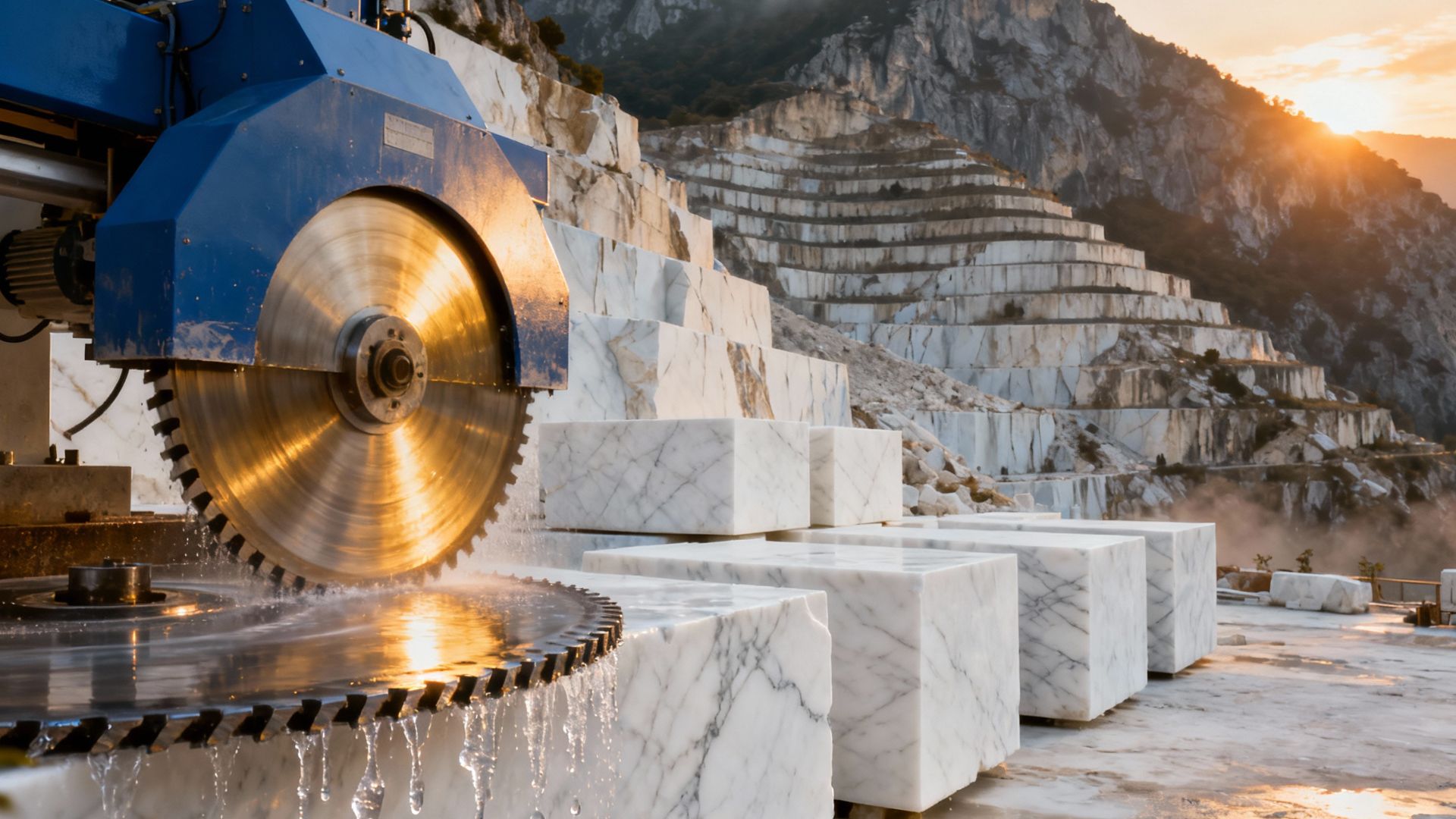
In the heart of the Apuan Alps, where white marble rises from the mountain like petrified snow, the roar of modern machinery blends with the echo of millennia of history. It is here—in the Italian quarries that have fueled art and architecture for over two thousand years—that a daily feat of balance takes place: the seamless integration of artisanal know-how passed down through generations with the most advanced technologies of the 21st century.
This synthesis of old and new is not a contradiction, but the very essence of Italian excellence in natural stone extraction. It proves that innovation and tradition—far from being rivals—can move together in harmony, producing extraordinary results.
The past living in the present
The origins: when humans first met stone
Stone extraction in Italy has roots that reach back to antiquity. The Romans were masters of quarrying and working marble, developing techniques that remained unmatched for centuries. They used wooden wedges inserted into natural fissures in the rock; when soaked, the wedges expanded slowly but relentlessly, splitting the stone along predetermined lines.
The Pantheon, the Colosseum, temples, and patrician villas testify to Roman mastery. But they also reveal something deeper: an intuitive understanding of stone—its nature, its “character.” This knowledge isn’t learned from books or technical manuals; it is passed from the trained eye of the master to the attentive apprentice through years of hands-on experience.
The Renaissance and beyond
During the Renaissance, Carrara’s quarries became the beating heart of world art. Michelangelo personally selected blocks for his sculptures, spending months in the quarries to find the perfect marble. Techniques became more refined: cutting with levers, transport via lizzature (wooden sledges), and increasingly sophisticated winches and pulleys.
Every innovation, however, was built upon consolidated knowledge. Quarrymen knew every vein of the mountain, could interpret the rock’s signals, and predict where a block would detach easily—and where it would resist.
Tradition as a foundation
This tradition is not nostalgia; it is a living heritage of practical, essential know-how:
Reading the rock: understanding geological structure, natural fracture lines, and variations in density
Respecting the material: never forcing stone, but working with its nature
Quality assessment: instantly recognizing a superior block
Intuitive safety: sensing risks and anticipating rock behavior during extraction
Waste optimization: maximizing yield from every extracted block
This traditional expertise remains the foundation on which modern technologies are built. Without it, even the most advanced machinery would deliver mediocre results.
The technological revolution in quarries
Diamond wire cutting: surgical precision
One of the most revolutionary innovations in stone extraction was the introduction of diamond wire cutting in the 1980s. This technology fundamentally reshaped the industry.
How it works:
A steel cable fitted with diamond beads is driven at high speed through the rock. Continuous motion and diamond abrasion cut the stone with millimetric precision.
Game-changing advantages:
Extreme accuracy: perfectly straight cuts with tolerances of just a few millimeters
Less waste: a very narrow kerf (a few millimeters versus 10–15 cm with traditional techniques)
Speed: cuts that once took days can now be completed in hours
Versatility: cuts in any direction, including horizontal or angled sections
Safety: a significant reduction in risk for operators
In the modern quarries from which Marmeria Italiana selects its materials, diamond wire is now standard. Yet its successful use still depends on the judgment of an experienced quarryman, who decides where and how to cut to optimize quality and yield.
Chain saws: power with control
Natural stone chain saws are industrial giants that combine brute force with sophisticated control. Conceptually similar to chainsaws for wood—but infinitely more robust—these machines use diamond chains capable of cutting marble and granite.
Key applications:
Vertical and horizontal separation cuts for block extraction
Refining quarry faces
Preliminary squaring of extracted blocks
Cutting in tight spaces where other equipment cannot operate
Technological evolution:
Modern chain saws feature hydraulic systems for pressure regulation, sensors that automatically adjust cutting speed to the rock’s hardness, and advanced cooling systems that prevent damaging overheating.
Hydraulic drilling rigs: preparing the way
Before cutting, drilling is often required. Modern hydraulic drilling rigs are engineering marvels:
Controlled power: drilling holes of various diameters with speed and precision
Variable depth: from a few centimeters to several meters
Precise angles: laser positioning ensures exact drilling orientation
Automation: programmable for predetermined drilling patterns
These holes may be used for controlled blasting (in some granite quarries), to house hydraulic wedges, or to guide diamond wire passage. Each hole is strategically placed—guided by the quarryman’s experience and deep understanding of the rock.
Hydraulic wedges: controlled force
An advanced evolution of the Romans’ wooden wedges, modern hydraulic wedges can exert enormous pressure (up to hundreds of tons) in a controlled, safe way.
How they work:
Inserted into drilled holes, they expand hydraulically, applying constant pressure that splits the stone along predetermined lines.
Advantages:
Full control: pressure increases gradually while rock response is continuously monitored
Safety: no explosives, no uncontrolled fragmentation
Precision: the stone separates exactly where intended
Gentleness: minimizes micro-fractures that could compromise marble quality
Advanced handling systems
Moving marble blocks weighing 20–30 tons requires specialized equipment:
Overhead cranes and tower cranes:
Equipped with computerized control systems, they lift and position blocks with centimeter-level precision. Load sensors prevent overload; anti-sway systems ensure smooth, safe movement.
Wheel loaders and specialized carriers:
Earthmoving machines adapted with hydraulic clamps that “embrace” blocks. Automatic leveling systems allow safe operation on uneven terrain.
Rail transport systems:
In some quarries, rails enable efficient transport of blocks from extraction areas to loading zones, reducing time and costs.
Digital technologies: Quarry 4.0
3D scanning and digital modeling
One of the most fascinating frontiers is the integration of 3D scanning technologies.
Terrestrial laser scanners map entire quarries, creating highly detailed 3D models of the mountain. These models make it possible to:
Plan extraction years in advance
Identify higher-quality zones
Accurately calculate available volumes
Virtually simulate different cutting strategies
Monitor quarry-face stability
Drones equipped with cameras and sensors fly over quarry sites, collecting data processed into topographic maps updated in near real time. They can reach hazardous areas without exposing workers to risk.
Planning and optimization software
Specialized programs analyze geological and structural data to suggest optimal extraction strategies:
Yield maximization: complex calculations determine the cutting sequence that produces the most usable blocks
Waste minimization: identification of lower-grade zones for secondary products
Quality forecasting: algorithms based on historical data predict block characteristics before extraction
Resource management: optimization of machinery use, energy, and workforce
Real-time monitoring
Sensors distributed across the quarry continuously collect data:
Structural stability: inclinometers and accelerometers detect millimetric movements that may indicate instability
Environmental conditions: temperature, humidity, and wind speed impact operations
Machine performance: monitoring wear, efficiency, and maintenance needs
Safety: automatic alerts when potentially dangerous conditions arise
Blockchain traceability systems
Blockchain technologies are being implemented to guarantee complete traceability.
Each extracted block receives an immutable digital identity recording:
Date and location of extraction
Geological and quality characteristics
The journey from quarry to client
Environmental and quality certifications
Final destination
This ensures total authenticity—essential in a market where Italian origin is synonymous with premium quality.
The perfect integration: people and machines
The modern quarryman: operator and artisan
The 21st-century quarryman is a fascinating hybrid figure. They operate sophisticated machinery that requires advanced technical skills, yet they retain the trained eye and intuition of the traditional artisan.
Modern technical skills:
Programming and controlling computerized systems
Interpreting digital data and 3D models
Maintaining high-tech equipment
Using specialized software
Irreplaceable traditional skills:
Intuitive rock reading
Experience-based quality assessment
Operational decisions in unpredictable situations
Deep material understanding
This dual nature is not a contradiction but a powerful synthesis. Technology amplifies human expertise, but cannot replace it. An algorithm may suggest where to cut, but it is the quarryman’s eye that decides whether that cut is truly optimal in that specific real-world context.
Continuous training: tradition renewed
Leading companies—such as those supplying Marmeria Italiana—invest heavily in training:
Modern apprenticeship programs where young workers shadow experienced masters, learning simultaneously:
Advanced technologies through specialized courses
Traditional know-how through observation and guided practice
Safety through simulations and intensive training
Ongoing upskilling for experienced staff:
Courses on new technologies and machinery
Workshops on digital innovation
Sharing best practices across different quarries
International professional certifications
Hybrid decision-making
Critical quarry decisions arise from the integration of:
Objective data: 3D scans, geological analyses, optimization calculations, predictive models generated by sophisticated algorithms
Subjective experience: the quarryman’s intuition, sensory evaluation of rock, decades of accumulated knowledge, and “feel” for the material
This integration creates a higher decision-making level than either people or technology could reach alone.
Sustainability: innovation serving the environment
Reducing environmental impact
Modern technologies have enabled remarkable progress in sustainability:
Cutting precision: diamond wire reduces waste by 70–80% compared to traditional methods. Less waste means less residue to manage and greater respect for natural resources.
Energy efficiency: modern machinery consumes significantly less energy per extracted ton. Energy recovery systems, high-efficiency electric motors, and route optimization reduce carbon footprint.
Water management: recycling systems allow up to 90% of water used in cutting processes to be reused. Treatment plants purify water before release.
Dust reduction: controlled misting and dust suppression systems improve air quality and operator health.
Circular economy in extraction
Technological innovation has made it possible to valorize what was once considered waste:
Granulates and aggregates: cutting waste is crushed and graded for construction materials, composites, and landscaping.
Calcium carbonate: marble dust is collected and refined for industrial applications—from paper to pharmaceuticals, paints to toothpaste.
Blocks and paving units: pieces too small for slabs become paving, cladding, and decorative elements.
Environmental restoration: residues can help fill exhausted quarry areas, reshaping natural profiles and enabling vegetation recovery.
Continuous environmental monitoring
Sensors around quarry areas constantly track:
Air quality and fine dust levels
Noise levels
Vibrations that could affect wildlife or nearby homes
Surface and groundwater quality
Biodiversity and protected species presence
Collected data enables rapid intervention to minimize negative impacts—proving that extraction and environmental responsibility can coexist.
Safety: technology as a non-negotiable priority
Historically, quarry work was among the most dangerous. Modern technologies have changed this dramatically:
Automation of high-risk operations: remote-controlled machines can operate in unstable zones without exposing workers
Stability monitoring systems: sensor networks detect even millimetric movements, providing early warnings of potential detachments or collapses
Advanced PPE: helmets with integrated sensors, clothing with geolocation systems, always-on communication devices
Automatic alert systems: in dangerous conditions, alarms trigger automatically and operations are suspended
Safety training has also evolved: virtual simulators allow emergency training without real risk, while augmented reality supports immersive learning to recognize and manage critical situations.
The future: toward ever smarter quarries
AI and machine learning
AI is entering quarries with highly promising applications:
Predictive maintenance: algorithms analyze machinery data to anticipate failures before they happen, reducing downtime and costs
Real-time optimization: AI can suggest adjustments to extraction strategy based on continuously changing conditions
Automated quality recognition: computer vision systems can assess block quality by analyzing veining, color, and density
Collaborative robotics
Collaborative robots (cobots) may support operators in precision tasks, combining machine strength and repeatability with human intelligence and flexibility.
Zero-impact extraction
Research is pushing toward extraction technologies designed to leave no environmental footprint:
Digital pre-modeling of post-extraction restoration
Cutting techniques that allow geological reconstitution of the area
Quarries conceived from the outset with final restoration in mind
The best of both worlds
Italy’s stone industry has achieved something remarkable: embracing cutting-edge innovation without betraying the tradition that made it famous worldwide. Italian quarries are now among the most technologically advanced on the planet, yet they retain that artisanal essence, that respect for material, and that pursuit of excellence that have defined them for millennia.
When you choose Italian natural stone, you choose the outcome of this extraordinary synthesis: a material extracted with state-of-the-art technologies that ensure quality, sustainability, and safety—yet selected and handled with the expert eye of artisans carrying forward millennia of knowledge.
That is the essence of Italian excellence: not rejecting the new out of nostalgia, nor forgetting the past in enthusiasm for innovation—but creating a higher harmony where tradition and technology strengthen each other.
Marmeria Italiana, with over 35 years of experience, works exclusively with quarries that embody this philosophy: where modern technology serves to enhance the intrinsic quality of Italian natural stone, where innovation supports tradition, and where the result is absolute excellence in every block, every slab, every project.
